Pepper’s Ghost:The Illusion That Gave Birth to Holography
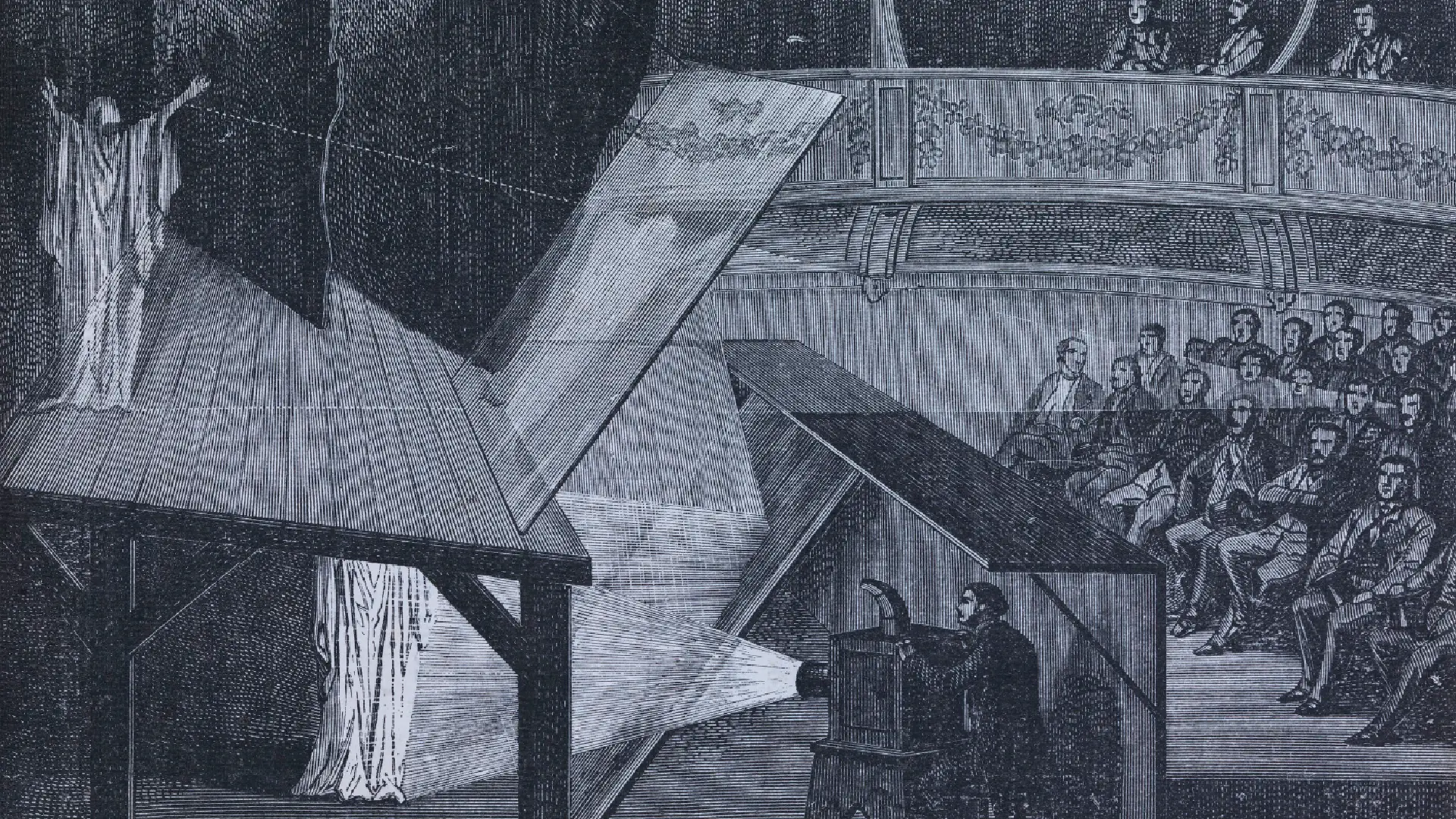
Long before digital light fields, volumetric capture, or AI generated avatars, the foundation of holographic storytelling began with a Victorian stage illusion known as Pepper’s Ghost. What audiences today describe as holograms in retail, entertainment, and cinema can trace their conceptual lineage back to this single theatrical breakthrough. It was not digital. It was not powered by projection mapping or transparent OLED. It was an elegant manipulation of light, reflection, and perception that ignited humanity’s obsession with bringing the unreal into physical space.
Origins in Victorian Britain
Pepper’s Ghost emerged in the mid 19th century, formally introduced to the public in 1862 at the Royal Polytechnic Institution in London. The effect was popularized by Professor John Henry Pepper, a scientist and educator, though the original concept was developed by engineer Henry Dircks. Dircks devised a method of reflecting an actor from a hidden chamber onto a stage using angled glass. Pepper refined the staging mechanics so it could be installed in existing theatres, making the illusion commercially viable.
Victorian audiences had never seen anything like it. At a time when photography itself still felt magical, the sudden appearance of translucent figures on stage blurred the boundary between science and the supernatural. Theatre productions such as Charles Dickens’ The Haunted Man used the illusion to manifest ghosts that could materialize, move, and disappear in front of live audiences.
Contemporary reports describe viewers recoiling in fear, applauding in disbelief, and returning repeatedly to experience the phenomenon again. The illusion was not merely entertainment. It was emotional engineering.
The Technical Process Behind the Illusion
Pepper’s Ghost relies on a deceptively simple optical principle.
A large sheet of glass or transparent material is positioned at an angle between the audience and the stage. Hidden from direct view, a secondary space contains an actor or object brightly illuminated against a dark background. Light reflecting off this hidden subject bounces onto the angled glass, which then reflects the image toward the audience.
Because the glass is transparent, viewers simultaneously see the physical stage and the reflected figure. The result is a semi transparent apparition that appears to occupy real space.
Key technical components include:
- Angle of reflection: Typically 45 degrees for optimal image placement
- Controlled lighting: Bright illumination in the hidden chamber, darkness on stage
- High contrast costuming: Enhances visibility of the reflected subject
- Precise sightline management: Ensures the illusion holds from audience viewpoints
There is no projection in the modern sense. No pixels. No screens. Only reflected light and human perception completing the illusion.
Psychological Impact and Audience Response
Pepper’s Ghost succeeded because it exploited how the brain interprets depth, transparency, and presence. Humans instinctively trust reflected light as real. When a reflected figure aligns spatially with physical scenery, the mind accepts it as existing within the same dimensional plane.
Victorian theatre records indicate that shows featuring Pepper’s Ghost increased ticket demand significantly. Some venues reported attendance uplifts exceeding 30 percent when the illusion was featured in marketing materials. The spectacle became a commercial driver, not just a creative tool.
This marked one of the earliest examples of immersive visual technology generating measurable economic impact through attention capture.
From Stage Illusion to Proto Holography
Although Pepper’s Ghost is not a hologram in the scientific sense, it established the conceptual blueprint for holography.
Core shared ambitions include:
- Creating volumetric presence from light
- Blending digital or projected imagery with physical environments
- Evoking emotional responses through perceived realism
- Suspending disbelief through spatial illusion
As projection technology evolved in the 20th century, engineers began replacing live actors in the hidden chamber with filmed footage. This allowed prerecorded “ghosts” to appear, expanding scalability and repeatability.
By the late 1900s, the technique was being adapted for museums, theme parks, and brand activations. Disney’s Haunted Mansion, for example, uses a refined Pepper’s Ghost system to animate spectral ballroom dancers, demonstrating the illusion’s longevity and reliability.
Cinematic Influence and Cultural Imagination
Pepper’s Ghost did more than influence stagecraft. It shaped how filmmakers imagined future communication and interface technologies.
Star Wars and the Holographic Message
One of the most iconic hologram scenes in cinema history appears in Star Wars: A New Hope, where R2-D2 projects Princess Leia’s plea for help. The shimmering, volumetric figure established a visual language for holographic communication that persists today.
While achieved through film effects rather than stage reflection, the conceptual lineage is clear. A translucent human figure occupying real space, communicating information, rooted in the same perceptual fascination that powered Pepper’s Ghost.
Iron Man and Spatial Interfaces
The Marvel Cinematic Universe pushed this further. Tony Stark’s holographic interfaces, manipulable in mid air, represent the evolution from illusion to interactive light computing. These scenes blend volumetric projection, gesture control, and spatial UI design, all built upon the original ambition of manifesting data physically.
Audience research conducted by studios has shown that holographic interface scenes consistently rank among the most memorable futuristic visuals in blockbuster films, reinforcing public appetite for real world equivalents.
Modern Commercial Holography
Today’s holographic display systems, including transparent LCD, LED fan arrays, light field displays, and mixed reality glass, all owe philosophical debt to Pepper’s Ghost.
Many contemporary “hologram” installations still use reflective illusion techniques because of their scalability and brightness advantages in high footfall environments.
Retail studies indicate that holographic style displays can generate:
- Up to 3 times more viewer engagement than flat screens
- Dwell time increases exceeding 25 percent
- Recall rates significantly higher than static signage
These performance metrics mirror the attendance surges seen in Victorian theatres, proving that while the technology stack has evolved, the psychological effect remains constant.
Why the Illusion Endures
Pepper’s Ghost persists because it satisfies a timeless human desire. We want stories, people, and information to step out of frames and into our world.
From haunted theatres to cinematic galaxies to AI powered retail avatars, the trajectory is continuous. Each technological leap refines brightness, realism, interactivity, and scale, yet the emotional objective remains unchanged.
To make light feel alive.
To collapse the boundary between imagination and environment.
To transform passive viewing into spatial experience.
Pepper’s Ghost stands as the origin point of holographic ambition. Born in Victorian Britain through glass, light, and theatrical ingenuity, it triggered a global fascination with volumetric illusion that continues to shape entertainment, communication, and commerce.
Modern holograms may use advanced optics, real time rendering, and artificial intelligence, but they are all descendants of that first ghostly reflection on a London stage.
The technology has evolved.
The desire it serves has not.
Further Reading
- Explaining the Pepper’s Ghost Illusion with Ray Optics
- What Is The Pepper’s Ghost Effect Inside The Haunted Mansion
- Spectral Illusions: The Pepper’s Ghost Effect
- What Makes Hologram Advertising So Powerful for Business Growth?
- The future of retail. Merge the physical and digital worlds with holograms.