Sight AND Sound : The Dynamic Shift in DOOH That Grabs Attention and Increases Dwell Time.
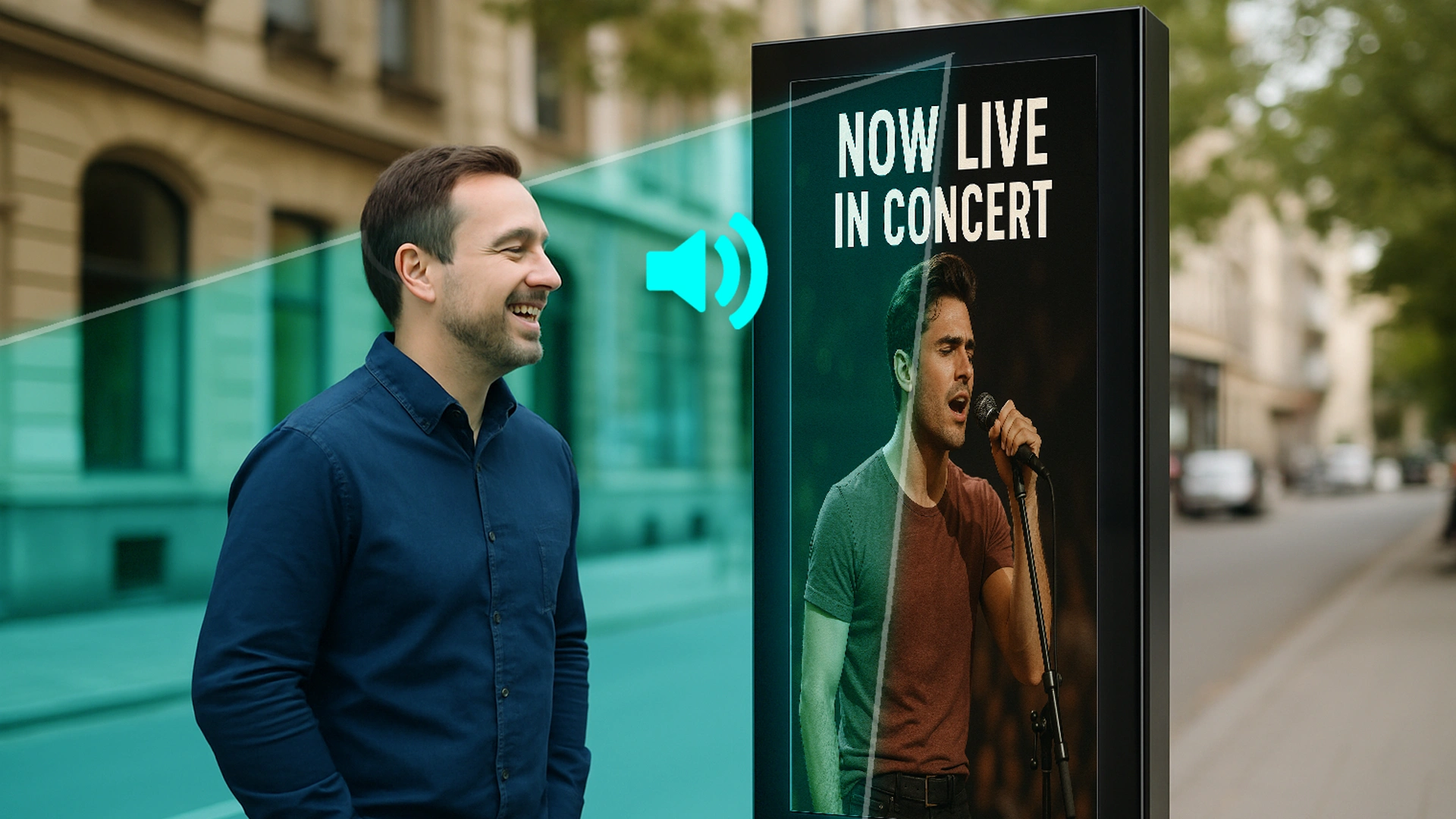
DOOH screens have always depended on strong visuals, but adding targeted, localised audio dramatically boosts dwell time, engagement, and trust in ways visuals alone can’t match.
Why Adding Sound Matters in DOOH
From a social-science and cognitive perspective, sound activates different neural pathways than vision. It helps anchor attention, adds temporal structure to the visual experience, and provides a richer memory trace. According to research by ITAB, when a soundscape was added in a mall in Helsinki, dwell time increased by 8 percent, an uplift that was independently linked to a very large potential boost in sales. (ITAB)
In retail environments more broadly, curated in-store audio can drive meaningful behavioural effects. According to one industry report, in-store audio increased customer dwell time by up to 39 percent, while 82 percent of shoppers said that it influenced their purchasing decisions. (commercial.co.uk) Another source suggests that carefully selected music or ambient audio can boost in-store spend by 9.1 percent. (Australian Retailers Association)
These data points illustrate that the addition of sound does more than decorate the environment; it fundamentally changes how people experience the space, how long they stay, and even what they choose to buy.
The Risks of Uncontrolled Audio Everywhere
However, adding audio to every digital screen without constraint is not a viable strategy. If every DOOH display blared sound, the result would likely be cacophony and annoyance. Human beings become cognitively overloaded by overlapping sources of sound, which can degrade trust in the environment, reduce message clarity, and provoke avoidance.
Empirical research supports these concerns. The ergonomics of sound suggest that prolonged exposure to loud or pervasive audio can lead to discomfort. Some studies note that volumes above 60 dB prompt negative reactions in public spaces. (advision.digital) Moreover, from a retail-acoustics standpoint, even modest increases in dwell time matter. A white paper on retail acoustics shows that improving acoustic comfort, for example by limiting intrusive audio, is correlated with sales increases, with as little as a 1 percent rise in dwell time translating into approximately a 1.3 percent increase in sales. (Scribd) In short, poorly designed audio DOOH could backfire.
Localised Audio: The Solution That Scales
The ideal solution lies in localising sound so that only people close to the screen hear it clearly. Directional audio, or beam-forming technology, enables this by focusing sound energy very precisely. This avoids polluting the broader soundscape while still giving passersby a high-fidelity audio experience.
A leading provider in this space is HOLOPLOT. Their matrix-array, high-precision beamforming systems can direct sound to very specific areas. Notably, HOLOPLOT’s X1 Matrix Array powers the Sphere in Las Vegas, a venue with 1,586 permanently installed speakers. (Wikipedia) This kind of technology makes it feasible to deploy audio in DOOH settings in a way that is both high-impact and spatially constrained.
By using this advanced directional audio, a DOOH screen can deliver spoken messages, sonic branding, or spatial audio effects to those standing directly in front, without contributing to general noise or irritating pedestrians just a few meters away.
How This Integrates with Miirage Holograms and Retail Media
Miirage operates at the intersection of holography, retail media, and real-world experiential marketing. Localised audio systems align perfectly with this mission. When a Miirage hologram speaks, beam-formed audio can make its voice appear to originate precisely from the hologram’s location in 3D space. This spatial congruence between vision and sound significantly strengthens the illusion of presence.
This realism builds trust. When the hologram’s voice seems to emanate from the same place as its form, people perceive it as more believable, more authentic, and more grounded. In a media ecosystem where consumer trust is critical, that alignment is powerful.
From a retail-media standpoint, integrating localised audio into DOOH or holographic activations enables context-aware messaging. For example, Miirage can trigger short voice cues when a customer pauses in front of a hologram or play branded sonic IDs at times of high footfall. Because the audio is localised, it avoids disturbing customers elsewhere in the space. That makes the experience more comfortable, less invasive, and more likely to be welcomed by shoppers.
Best Practices and Measurement
To deploy sight plus sound effectively, certain design principles are critical.
Restrict audio to moments when users are likely to stop, such as queue points, product experiences, or interactive zones.
Use short, intelligible messages rather than long-form content, focusing on sonic branding, voice prompts, or minimalistic audio cues.
Control volume and directionality through beamforming so that audio is audible only to intended listeners.
Measure carefully by comparing before and after audio deployment using metrics like dwell time, impression duration, and conversion such as footfall or sales. Use proximity sensors or footfall counters to isolate effects.
In terms of KPIs, combining audio-addition data with standard DOOH metrics can produce a clear picture of impact. For instance, footfall sensors can detect increased dwell time in audio zones, while retail media analytics can map that to conversion or recall.
The integration of sight and sound represents a dynamic shift in DOOH strategy. When sound is localised and carefully controlled, it amplifies engagement without overwhelming the environment. For Miirage, this means creating holographic experiences that are not only visually arresting, but audibly credible and deeply trustworthy. By leveraging technologies such as HOLOPLOT’s beamforming arrays, Miirage can enrich real-world interactions and deliver retail-media campaigns that command attention, build memory, and deliver measurable outcomes.
In today’s market, where multisensory strategy is rapidly becoming the new baseline, sight plus sound is not just an innovation. It is an imperative.
Further Reading
- The influence of sound on dwell times and sales – ITAB
- In-store Audio – commercial.co.uk
- Striking a chord with customers through music – Australian Retailers Association
- Research – audio advertising in retail (40–50 dB) – Advision
- Acoustics in Retail Environments WhitePaper – Scribd
- Sphere (venue) – Wikipedia (HOLOPLOT reference)